
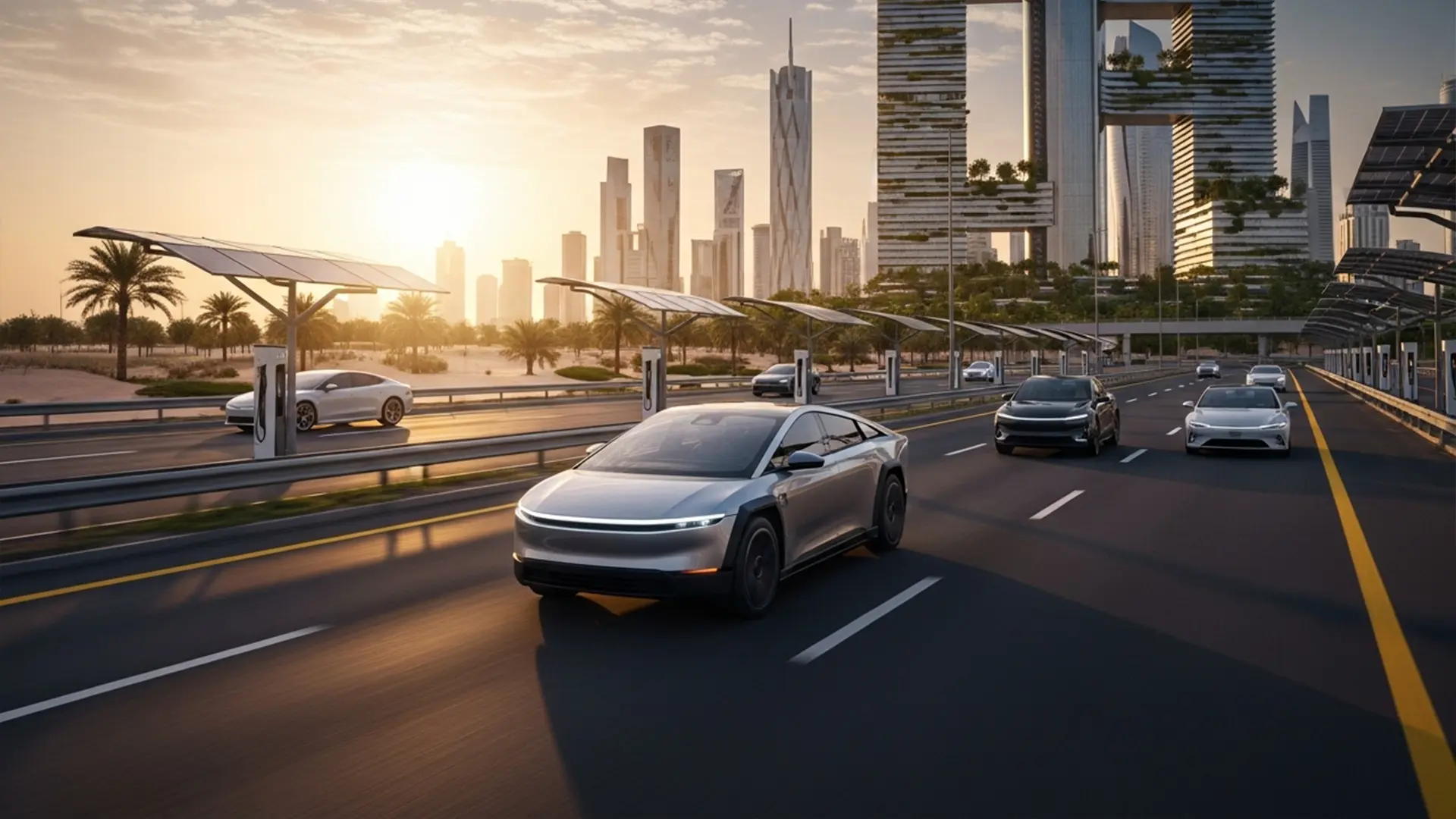
Electric car financing in Saudi Arabia is becoming more accessible than ever, as the Kingdom accelerates its shift toward sustainable mobility under Vision 2030. From international brands like Tesla and BMW to emerging Chinese EVs gaining strong market traction, Saudi consumers now have more electric vehicle choices — and more flexible Sharia-compliant financing structures — than at any point before. This guide covers your EV financing options with Taajeer Finance, how Islamic financing applies to electric vehicles, and what to consider about a car’s future residual value before you sign.
Saudi Arabia is quietly—but decisively—reshaping its automotive future. Once defined almost entirely by large displacement engines and subsidized fuel, the Kingdom is now laying the groundwork for a mobility ecosystem where electric vehicles (EVs) are not a novelty, but a logical next step.
This shift is not driven by trend alone. It is powered by Vision 2030, economic diversification, rapid urban development, and a growing awareness that ownership value goes far beyond what happens at the fuel pump. Electric cars in Saudi Arabia sit at the intersection of policy, infrastructure, personal finance, and long-term asset value.
For buyers, the real questions are no longer “Are EVs coming?” but “How do I finance one wisely?” and “Will it hold its value in the Saudi market?”
This guide answers both—without hype, without assumptions, and with a clear focus on practical decision-making.
TL;DR
Electric Cars in Saudi Arabia are becoming financially viable thanks to improving financing options, expanding charging infrastructure, and lower long-term ownership costs. While upfront prices remain higher than gasoline cars, reduced operating expenses, strong battery warranties, and Vision 2030-backed adoption are improving resale value and long-term returns.
1. The Saudi EV Shift: Why Now
Saudi Arabia’s move toward electric mobility is structural, not experimental. Several forces converge here:
- Vision 2030 prioritizes sustainability and reduced oil dependency
- Urban expansion favors cleaner, quieter transport
- Younger buyers expect tech-forward vehicles
- Corporate fleets seek lower operating costs
What makes electric cars in Saudi Arabia unique is context. Long driving distances, high summer temperatures, and a historically fuel-cheap environment demand EVs that are robust, well-supported, and financially justified.
Manufacturers, financiers, and infrastructure developers have adjusted accordingly. The result? EV ownership is no longer an early-adopter gamble—it’s a calculated option.
2. Financing Electric Cars in Saudi Arabia: What Buyers Need to Know
A Market Catching Up—Fast
Financing has long been the missing link for EV adoption in KSA. That gap is now closing. Banks and financial platforms increasingly treat EVs not as experimental assets, but as mainstream vehicles with predictable risk profiles.
Modern auto financing in Saudi Arabia typically offers:
- Competitive profit rates
- Flexible repayment terms
- Sharia-compliant structures
- Eligibility for both new and certified pre-owned EVs
Platforms like Taajeer Finance have emerged to simplify this process, connecting buyers with tailored vehicle financing solutions that align monthly payments with realistic ownership costs.
Why EV Financing Feels Different
Unlike gasoline cars, EVs shift cost from operation to acquisition. Financing smooths that curve.
Instead of paying more every month at the pump, buyers pay a slightly higher installment—then spend far less on fuel, servicing, and maintenance. Over time, the math starts to favor electricity.
For buyers exploring structured auto financing options, dedicated EV and auto financing solutions make it easier to compare true monthly cost, not just sticker price.
3. Comparison: Electric Car vs. Gasoline Car Ownership Costs in KSA
Upfront Cost vs. Lifetime Cost
On paper, gasoline cars still look cheaper. In reality, ownership tells a different story.
Fuel vs. Electricity
- Gasoline prices fluctuate
- Electricity pricing remains stable
- Home charging dramatically reduces per-kilometer cost
For high-mileage drivers, EVs can cut “fuel” expenses by more than half annually.
Maintenance Reality
Electric cars eliminate or reduce:
- Oil changes
- Transmission servicing
- Exhaust system repairs
- Engine-related failures
In KSA’s climate, fewer moving parts translate into fewer heat-related issues—an often-overlooked advantage.
Depreciation Patterns
Gasoline cars depreciate predictably. EVs, by contrast, are beginning to stabilize as consumer confidence rises and battery warranties extend.
Bottom line: In Saudi Arabia, total cost of ownership increasingly favors electric cars—especially for urban and commuter-heavy drivers.
4. The Evolution of EV Charging Infrastructure in Saudi Arabia
From Concern to Confidence
Charging anxiety once defined EV hesitation. Today, that concern is steadily fading.
Saudi Arabia has invested heavily in:
- Urban fast-charging hubs
- Highway charging corridors
- Commercial and residential installations
Major cities now support daily EV usage without compromise.
Home Charging: The Real Game-Changer
Most EV owners in KSA charge at home overnight. This changes everything.
- Lower electricity cost
- No waiting lines
- Predictable routine
For villa and private parking owners, charging becomes as effortless as plugging in a phone.
What’s Next?
Expect rapid expansion tied to:
- New residential developments
- Smart city initiatives
- Commercial fleet electrification
The charging conversation is no longer “Is it available?” but “How fast and how convenient?”
5. Top Electric Car Models Available in Saudi Arabia
Saudi buyers now have real choice—across segments and price points.
Premium Segment
- Tesla Model S / Model X – Performance-driven, long-range leaders
- Mercedes EQS – Luxury-first EV with refined ride comfort
Mid-Range Segment
- Tesla Model 3 / Model Y – Popular, efficient, well-supported
- BMW i4 – Combines EV efficiency with familiar driving dynamics
Entry-Level and Emerging Options
- Hyundai Ioniq series
- Kia EV lineup
- BYD electric cars
What matters most in the Saudi market is not brand alone—but:
- Heat-tested battery systems
- Local service availability
- Software support and updates
6. Battery Life and Warranty: What to Expect from Your EV in KSA
The Question Everyone Asks
Battery longevity is the defining concern for EV buyers. Fortunately, the reality is far more reassuring than the myth.
Most modern EVs offer:
- 8 to 10-year battery warranties
- Coverage for capacity degradation
- Manufacturer-backed replacement policies
Heat and Battery Health
Manufacturers selling EVs in Saudi Arabia calibrate thermal management systems specifically for high temperatures. Active cooling, software regulation, and charging safeguards protect long-term battery health.
Real-World Degradation
Under normal use:
- Annual degradation averages 1–2%
- Batteries remain functional far beyond warranty periods
- Resale buyers increasingly accept used EVs with confidence
Battery risk, once a deal-breaker, is now a managed variable.
7. Future Value and Resale Outlook for EVs
Will EVs Hold Their Value in Saudi Arabia?
Short answer: increasingly, yes.
Several factors support this trend:
- Rising fuel efficiency awareness
- Improved infrastructure
- Strong manufacturer warranties
- Government-led sustainability goals
As adoption grows, secondary markets mature. Early depreciation curves are flattening.
The Fleet Effect
As corporations and ride-hailing services electrify fleets, demand for used EVs will rise—supporting resale value across the market.
EVs are transitioning from speculative assets to stable, depreciating vehicles—just like gasoline cars, only cleaner.
8. How to Decide If an EV Makes Financial Sense for You
Ask yourself:
- Do you drive mostly in urban or suburban areas?
- Can you install home charging or access workplace charging?
- Do you plan to keep the car for 5+ years?
If the answer is “yes” to most, electric ownership likely makes financial sense.
EVs reward consistency. The longer you own them, the clearer the advantage becomes.
9. Frequently Asked Questions (FAQ)
Are electric cars suitable for long-distance driving in Saudi Arabia?
Yes. With expanding highway chargers and long-range models exceeding 500 km per charge, intercity travel is increasingly practical.
Do EVs require special insurance in KSA?
No. EVs are insured similarly to gasoline cars, though premiums may vary based on vehicle value and repair networks.
Can EVs handle Saudi summers?
Modern EVs sold in KSA are engineered with advanced thermal management systems designed for extreme heat.
Is financing an EV harder than financing a gasoline car?
Not anymore. Many financial institutions now treat EVs as standard vehicles, offering competitive financing terms.
10. Conclusion
Electric cars in Saudi Arabia are no longer a question of if, but when—and how wisely. Financing options are maturing. Infrastructure is expanding. Ownership economics are improving. Most importantly, future value is becoming predictable.
For buyers willing to think beyond fuel price and embrace total cost logic, EVs offer a compelling, forward-looking proposition—one aligned with where Saudi Arabia itself is heading.
The road ahead is electric. The smart move is understanding it before you drive it.
